Origins
Reflecting Shared Values
Origin stories speak to our creation—as people who descended from the sky, people who rose from the water, people who came from the earth, and people guided by the animals to learn how to be human.
We carried these stories with us from our ancestral homelands to this place we call Oklahoma. Through them, we share glimpses of our worldviews. We remember these things, and we teach them to our children. Through our stories, we know who we are.
Origin stories reveal the deeply embedded values that inform our respective and diverse ways of seeing and understanding the world. Every tribe has stories that explain how they came into existence on earth, where they came from, and provide guidance on how they structure their social, political, and religious institutions.
Each tribe has their own distinct Origin story. These stories carry our original teachings, describing how the Creator gifted us with our unique worldviews. These stories carry our rights and responsibilities within our philosophy and scientific knowledge.
Evidence of Enduring Presence
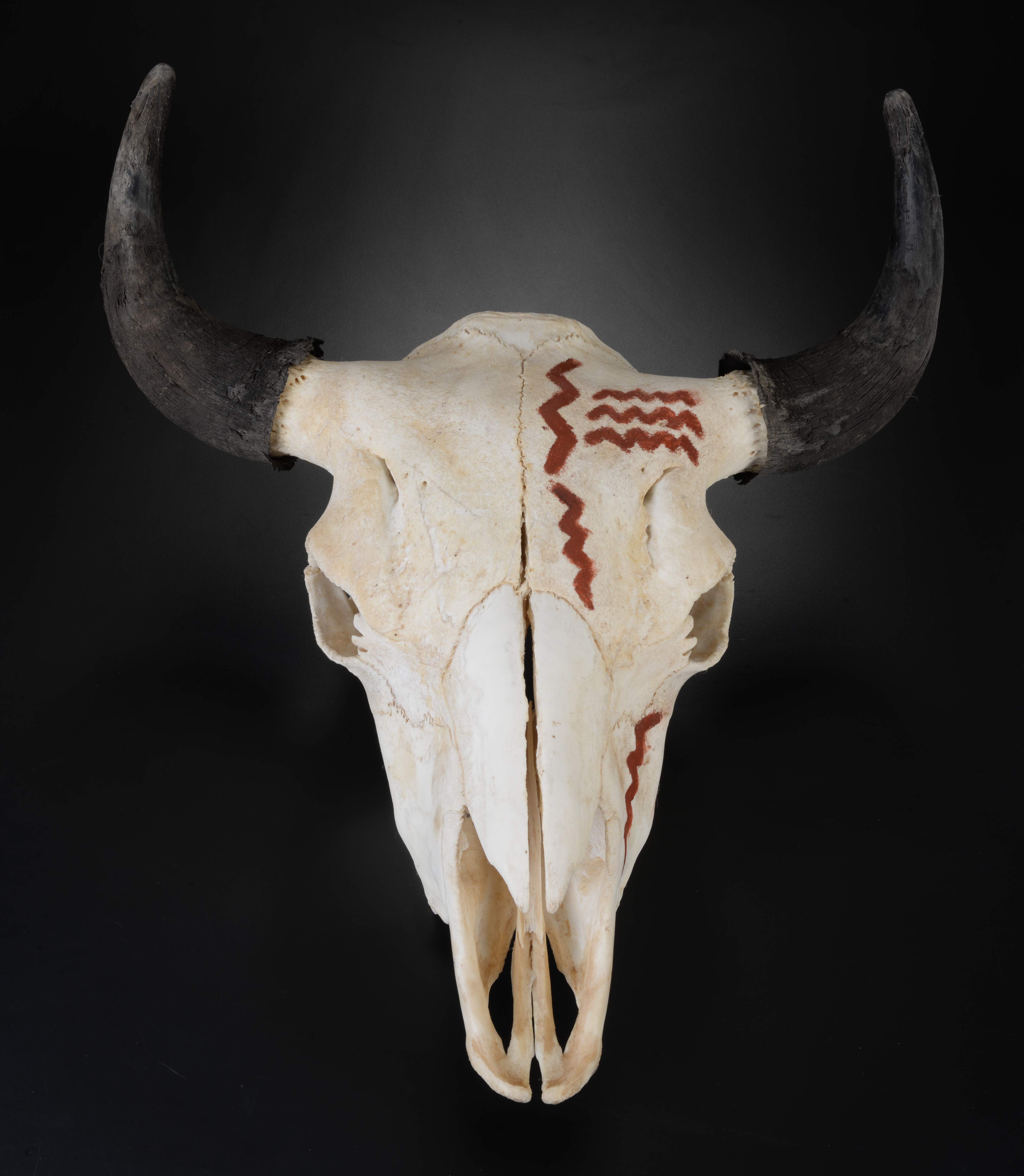
For thousands of years, bison were an abundant resource for First Americans. This bison skull, a careful reproduction, looks just like the one discovered along the North Canadian River in Harper County, Oklahoma.
Known as the Cooper Site Bison Skull, the original is more than 15,000 years old and is the oldest known painted object in North America. This object affirms what we already know from our Origin Stories—that First Americans have been here since time immemorial.
Origin Stories
FAM collaborated with four tribal nations (🔍Caddo Nation, 🔍Pawnee Nation, 🔍Yuchi (Euchee) Nation, and 🔍Otoe-Missouria Tribe) to script and record Origin Stories. These tribes also advised on the animation of these stories, which you can view inside the OKLA HOMMA exhibition at FAM.
✏️ Listen to and read these stories below. Use this organizer to capture your thoughts.
Caddo Story
A long time ago, as we traveled through darkness inside the earth, when people and animals spoke the same language, Nish, the Moon, came to our people with gifts. To the women / Cah-ah Na’ttih, Nish gave seeds of Kisi, corn, and Ka-kee-kus-nee, pumpkin. To the men / Cah-ah Shu’uwi’, came the T’ank’-uh, pipe, along with tobacco and flint. Nish foretold of our people’s journey through a deep darkness but promised these gifts would sustain us until we were led by Ta’sha into the light of Sah-cooh, the Sun.
Nish sent Ta’sha, the Wolf, to help guide us and gave our Ca dee, our chiefs, the drum and songs so our people would follow. Once we emerged, we were warned not to look back into the darkness and to keep moving forward. But Ta’sha was too curious and he looked back. There was a great shaking of the earth and the entrance collapsed.
We call this, Na Cha-cah-nee-nah, the place of crying for those that were left behind. In the end, we will all return to Wah-dut’ Ina’, our Mother Earth.
Pawnee Story
Nawa! In the beginning, there was only Tirâwa, the Great Spirit. His realm was shrouded in darkness where nothingness prevailed. Over time, He made the World as we know it today. To bring light, Tirâwa filled the firmament with stars. Hûpirit, the Star Beings, were assigned a role in Creation.
As the Mother-Of-All-Things, Čûpiriktâka, Evening Star, was given a garden in the Heavens and four helpers: Thunder, Lightning, Cloud, and Rain. Together, they formed the earth in a sacred manner: created plants as the sacred, living covering of Mother Earth; made her waters sweet; sprinkled seeds across the land; and released animals onto the earth. Life on earth pleased Tirâwa. Then came time to create akitâru’, the tribe.
Čûpiriktâka and Hûpirikucu, Evening Star and Morning Star, gave birth to Čûraki, a little girl named “Rain Standing.” To Sakûru and Pah, the Sun and the Moon, Pîraski, a little boy named “Closed Man” was born. The children were placed on earth on the banks of Ickari’, the Loup River. And this is how the Pawnee were created, in the natural order of things. The stars always shine brightly over their ancient homeland. Iriweturahe!
Yuchi (Euchee) Story
Tsoyaha Euchee-ha, Children of the Sun. We are obliged in our cyclical endeavors to acknowledge the need of place and emergence. Once there was nothing and all the creatures gathered together and made a song and only then was there substance and light. This light illuminating the straining backs of the origin creatures hard at work delivering the song, our existence.
The first to oblige this attempt was the beaver and then the fish otter. But it was the humble crayfish who first descended and brought forth the earth, dark and trembling from the depths. And the wondrous buzzard, who winged the air to form and dry the earth upon which the sun spilled her blood to ensure our being in a place where repeated whisperings became reality.
A place for the creatures to rise from the blood, to sing in the light of the moon and to dance in the warmth of the sun. It is from the blood of the sun that we rise daily and ascend the hill as Children of the Sun. Tsoyaha.
Otoe-Missouria Story
Aho! In the beginning, Wakonda, God, created the clan relatives the Otoe-Missouria people follow to this day. From rushing water, Manto birthed upon the earth. Arrogant and strong, he led his clan along the shores of fresh water. They see Lawe tracks and follow, ready to attack the strangers. Lawe-doge cried, “Halt! We are alone and will not hurt you. Join us, we have prepared a meal for you.” They traveled and came upon the Elk clan. Frightened by their strange antlers they rushed to attack.
The Huma-doge bugled, “Stop! Do not be afraid. Join us, we will feast and dance.” Manto prays, “Wakonda, we are here, we call upon you to teach us how to live.” Wakonda says, “The days ahead will be hard and you will help each other always. You will use this pipe to keep peace among you.” They travel together and came upon a village where the clans of Buffalo, Owl, Pigeon, and Snake live together.
Chehga-doge greets the new relatives. He offers their pipe to Manto. Manto refuses. Chehga-doge explains, “Wakonda brought us together, in peace we will live and thrive as one tribe forever.”
Our ancestors instilled within us the values of respect, responsibility, reciprocity, and relationships. These values are interwoven, as is our culture, art, science, politics, and religion. Our cultures were well established when European nations arrived. They came to our homelands with very different values.
European nations often separated art and culture from science and politics. Their worldviews were very different from ours. Concepts such as land ownership and capitalism did not exist in our world. Europeans exploited these differences to our detriment.
This began our struggle to remain First Americans.
Up Next
In the next section, you will explore the Ancient Roots of First American peoples across North America.